The Anthropolitan

The Anthropolitan
The Anthropolitan begins with an admission:
We were wrong.
Not about everything. Not in every intention. But in the architecture of the civilization we constructed and the definition of progress we allowed to govern it.
We were wrong to believe that an economy could expand forever upon a finite planet. We were wrong to measure human achievement through extraction, production, consumption, and accumulation. We were wrong to confuse excess with freedom, convenience with advancement, entitlement with liberty, and wealth with wisdom.
We were wrong to build communities around automobiles rather than people. We were wrong to allow food, shelter, medicine, energy, information, and even human attention to become instruments of corporate dependency. We were wrong to accept the manufacture of false needs as a legitimate foundation for economic stability.
Most dangerously, we were wrong to believe that admitting these mistakes would make us weak.
It would make us honest.
And honesty is where the Anthropolitan movement begins.
An Alternative Must Be Visible
Humanity does not suffer from a shortage of warnings. We have been warned by scientists, farmers, physicians, ecologists, economists, Indigenous communities, and increasingly by the atmosphere itself.
The problem is not that the evidence has been hidden. The problem is that our institutions have continued to present ecological responsibility primarily as sacrifice. People are told to consume less, travel less, reproduce less, expect less, and surrender familiar comforts—while the systems producing waste, inequality, isolation, and ecological destruction remain largely intact.
No population can be expected to abandon its existing way of life without being shown something more secure, meaningful, and desirable in its place.
This is where the nations of the world have failed the spirit of the Paris Climate Agreement. National pledges and policies remain collectively far from what is required to hold warming near 1.5 degrees Celsius. The United Nations Environment Programme concluded in 2025 that governments remained far from meeting the agreement’s temperature goals, while the United Nations reported that existing national plans would produce only a fraction of the emissions reductions needed by 2035.
The failure is not merely technical. It is imaginative.
Governments have discussed carbon targets without sufficiently challenging the economic demand for perpetual growth. They have promoted electric vehicles without questioning communities that make private vehicles necessary. They have discussed renewable energy while leaving the machinery of artificial demand untouched. They have asked how we might power the existing system differently without asking whether the existing system is worthy of being preserved.
No nation has yet demonstrated, at meaningful scale, a complete alternative capable of aligning daily human life with ecological reality.
The Anthropolitan movement exists to build that alternative.
The Courage to Correct Our Course
America could play a central role in this transformation—but only if it first abandons the belief that leadership requires the performance of infallibility.
America does not reclaim international respect by insisting that it has always been right. It reclaims respect by demonstrating the courage to recognize where it went wrong and the ingenuity to build something better.
The nation that helped globalize industrial extraction can help pioneer ecological restoration.
The nation that elevated consumerism into a civic identity can demonstrate the dignity of sufficiency.
The nation that exported automobile dependency, planned obsolescence, industrial agriculture, disposable culture, and the mythology of limitless growth can redirect its extraordinary technological capacity toward autonomous, cooperative, human-scale communities.
Such an admission would not be an act of national humiliation. It would be an act of national maturity.
America could say to the world:
We mistook domination for leadership.
We mistook abundance for waste.
We mistook economic expansion for human advancement.
We created extraordinary technologies, but we too often directed them toward accumulating private wealth rather than securing the common good.
We now understand that liberty cannot survive indefinitely within a society where essential needs are controlled by distant institutions, where citizens are reduced to consumers, and where economic security depends upon the continuous destruction of the living world.
Therefore, we are changing course.
This pivot would direct America away from extraction, exponential material growth, false needs, excess, and entitlement. It would move the country toward durable goods, localized production, regenerative agriculture, shared infrastructure, ecological restoration, participatory government, and communities designed to provide their inhabitants with the foundations of a good life.
The Anthropolitan Community
An Anthropolitan is not defined by nationality, class, religion, ideology, or geography.
An Anthropolitan is anyone willing to participate in building a civilization aligned with common human needs and ecological limits.
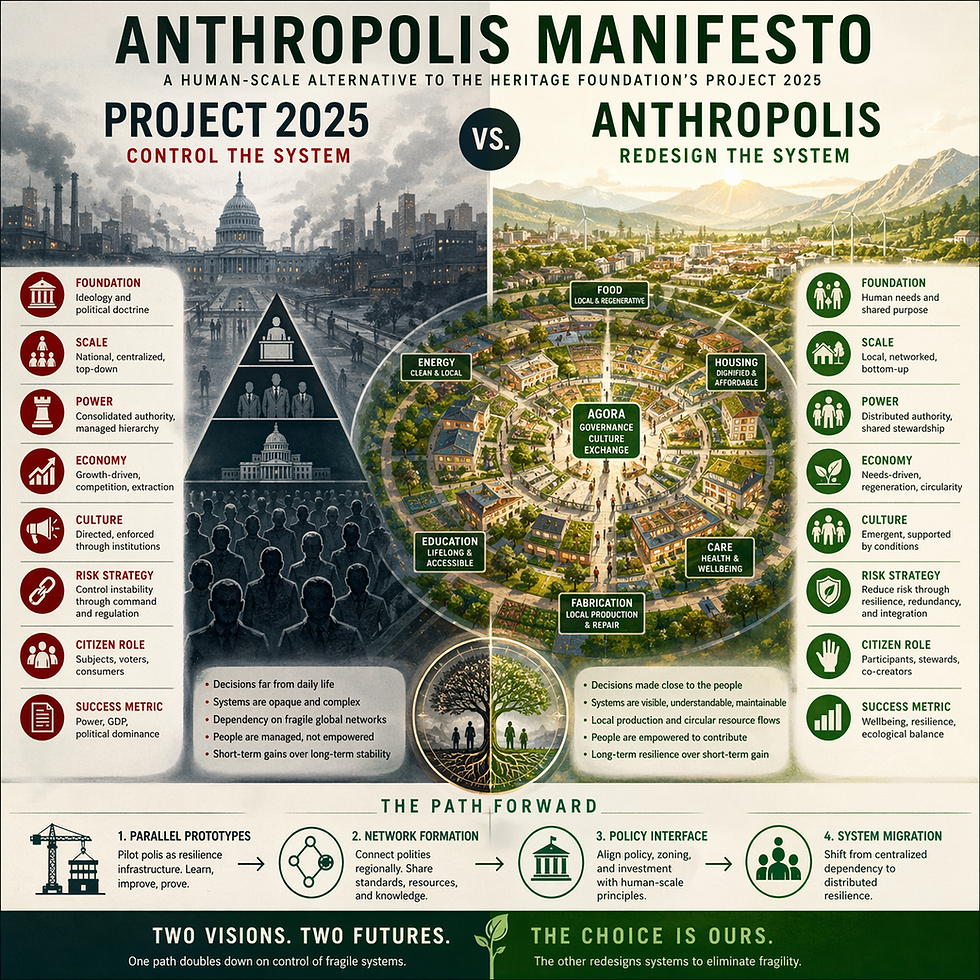
The physical expression of this movement is the polis: a human-scale community designed around food, water, shelter, health, education, mobility, energy, fabrication, civic participation, and belonging.
Advanced greenhouses would return food production to the center of civic life. Hydroponics, aquaponics, regenerative soil agriculture, food forests, seed libraries, preservation facilities, and community kitchens would reduce dependence on distant industrial supply chains. Renewable microgrids, water-recovery systems, shared transportation, repair centers, local manufacturing, and adaptable housing would give communities greater control over the systems upon which daily life depends.
Autonomy would not mean isolation.
Each polis would function as a connected cell within a wider network, exchanging knowledge, culture, technology, specialized goods, seeds, resources, and assistance with other communities. What could not be produced locally would be acquired cooperatively. What one polis learned could be shared with all.
The purpose would not be perfect self-sufficiency. It would be freedom from unnecessary dependency.
Technology would no longer be judged primarily by how rapidly it generates profit, eliminates employment, captures attention, or expands consumption. It would be judged by how effectively it reduces compulsory labor, strengthens communities, restores ecosystems, distributes knowledge, and improves the conditions of life.
A Defense Against Authoritarianism
Authoritarianism grows where people feel powerless.
It grows where institutions appear unresponsive, where economic life becomes precarious, where communities disintegrate, and where citizens lose meaningful control over their futures. It feeds upon humiliation, isolation, fear, resentment, and the suspicion that someone else has taken what rightfully belongs to us.
The authoritarian then arrives with simple explanations.
Your suffering is the fault of the immigrant.
Your insecurity is the fault of another race, religion, region, ideology, generation, or nation.
Give me greater power, the authoritarian promises, and I will restore the world you have lost.
But authoritarianism cannot restore what the economic system itself has dismantled. It cannot rebuild community through obedience. It cannot create belonging through exclusion. It cannot produce security through endless enemies.
The Anthropolitan movement offers a different response to powerlessness: participation.
When people help shape their communities, produce part of their food, govern shared resources, maintain public spaces, educate one another, and participate directly in decisions affecting their lives, they are less vulnerable to those who seek power by manufacturing fear.
A person who experiences democracy as a living daily practice is less likely to surrender it to a ruler promising protection.
Autonomous communities also weaken the forces that lead nations toward war. Competition for energy, fertile land, water, minerals, markets, and strategic supply chains becomes more dangerous as centralized societies demand ever-increasing quantities of resources. A civilization organized around sufficiency, distributed production, renewable systems, and ecological regeneration would reduce—not eliminate, but reduce—the material incentives for conquest and geopolitical domination.
Peace cannot be sustained only through treaties. It must be designed into the systems through which societies meet their needs.
Vision Without Coercion
The Anthropolitan movement does not seek to force humanity into a predetermined future.
It does not require propaganda, manipulation, compulsory ideology, or the silencing of dissent. Its power must come from demonstration.
The same technologies currently used to stimulate anxiety, manufacture desire, influence elections, and capture human attention can instead be used to make alternatives visible.
Digital models can allow people to enter and explore proposed communities before they are constructed. Immersive simulations can demonstrate how localized food, shared mobility, renewable energy, circular material systems, and participatory governance would function together. Open-source planning tools can allow citizens to redesign their own neighborhoods. Artificial intelligence can translate complex ecological and architectural systems into forms that ordinary people can understand, question, modify, and improve.
Films, virtual environments, interactive maps, public exhibitions, games, and digital civic forums can communicate the Anthropolis vision not as doctrine, but as an invitation.
People should be able to see the greenhouse in operation.
They should be able to walk virtually through the agora.
They should be able to understand where their water comes from, how their food is grown, how energy is stored, how waste becomes material, how decisions are made, and how their own participation contributes to the whole.
The movement must never manipulate people into agreement. It must give them enough information to make agreement unnecessary as an act of faith.
The proposition should be visible, testable, and open to correction.
Here is the community.
Here is what it requires.
Here is what it produces.
Here is what it costs.
Here are its risks.
Here is how it can be improved.
Come and see.
To Build Better
The Anthropolitan does not claim to possess a flawless blueprint for humanity.
That claim would repeat the arrogance that created the crisis.
Instead, the Anthropolitan accepts that civilization must become an evolving act of collective design. Communities must experiment, measure, learn, exchange knowledge, admit failure, and improve. No system should be protected from criticism merely because its founders believed themselves enlightened.
The distinction between the old world and the emerging one is not that one makes mistakes and the other does not.
The distinction is that the emerging world is willing to recognize its mistakes before they become sacred traditions, profitable dependencies, or irreversible catastrophes.
Humanity does not need another ideology demanding obedience.
It needs an alternative movement capable of proving that another way of living is possible.
A movement that recognizes the urgency of the climate crisis without surrendering to despair.
A movement that recognizes humanity’s failures without abandoning humanity.
A movement that uses technology not to dominate populations, but to reveal possibilities.
A movement that understands that the best protection against authoritarianism is meaningful participation, that the best defense against war is reduced dependency, and that the best response to ecological collapse is not a greener version of endless consumption, but a civilization no longer dependent upon it.
The Anthropolitan begins by admitting what we got wrong.
Not to remain trapped in guilt.
Not to erase everything humanity has created.
Not to retreat into a romanticized past.
We admit our mistakes because we intend to build better.
And for the first time, we possess the knowledge, tools, and collective capacity to make that admission the beginning of something extraordinary.