The Choice of Exile
- Pete Ward
- Oct 13, 2025
- 2 min read

The Choice of Exile
You stepped back.
Not in protest.
Not for recognition.
But because something no longer aligned—and you chose not to ignore it.
You saw how the system moves.
What it rewards.
What it extracts.
What it calls progress.
And you made a simple, difficult decision:
to participate more carefully.
That choice does not announce itself.
It rarely invites approval.
But it holds.
Because it is grounded in clarity.
You are not disengaged.
You are discerning.
You understand that most systems are not inevitable.
They are constructed—shaped by incentives, reinforced by habit, sustained by participation that is rarely examined.
To step back, even slightly, is to see this.
And once seen, you cannot fully return to unexamined involvement.
This is where the distance begins.
Not as exile in the dramatic sense,
but as a shift in position.
You no longer move automatically.
You choose where to stand.
Where to contribute.
Where to withhold.
Quietly.
Deliberately.
Without spectacle.
There is a cost to this.
You may be misunderstood.
Your restraint may be read as indifference.
Your clarity as criticism.
But you are not trying to oppose for its own sake.
You are trying to remain in alignment—
with what sustains life,
with what holds over time,
with what does not depend on abstraction to function.
This is not a rejection of participation.
It is a refinement of it.
You still live within these systems.
You still rely on them in ways you cannot fully control.
But you no longer confuse necessity with endorsement.
And that distinction matters.
Because it creates space—
not for withdrawal,
but for redesign.
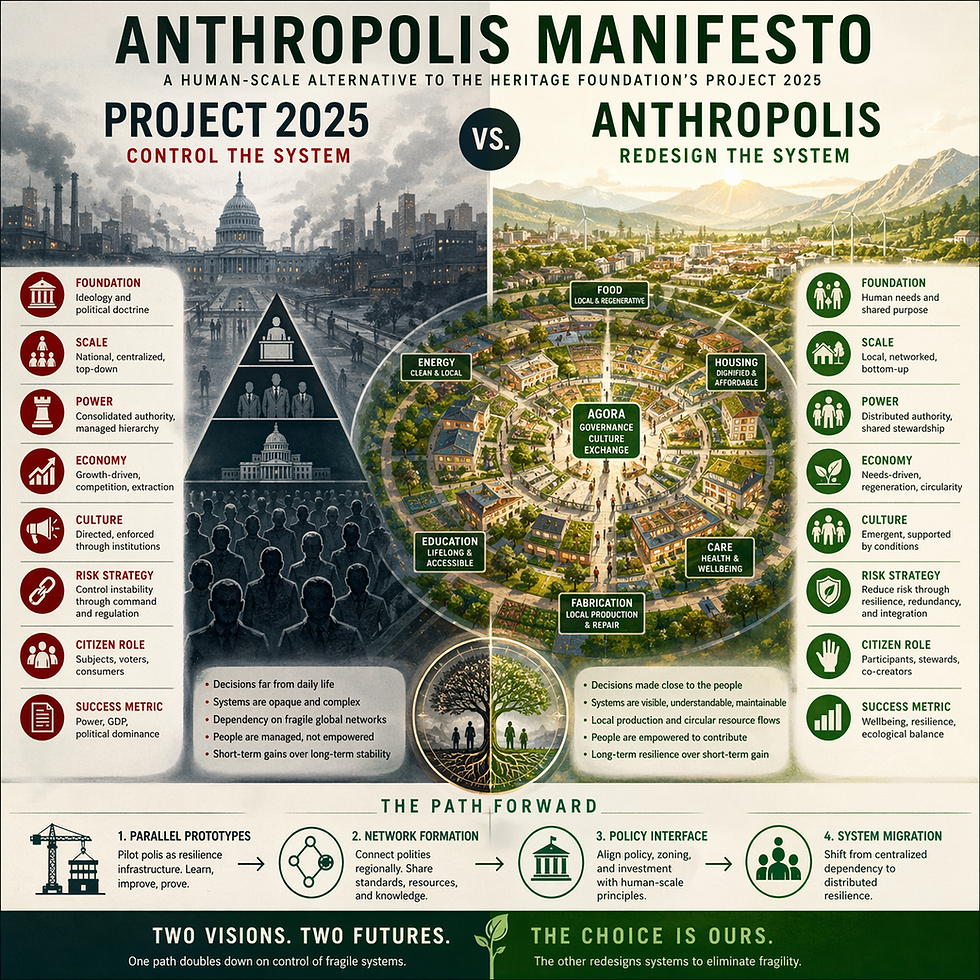
This is where the Anthropolis perspective becomes relevant.
If enough individuals experience this same misalignment—
if enough people begin to question how food is produced,
how shelter is built,
how care is delivered,
how decisions are made—
then the issue is no longer personal.
It is structural.
Anthropolis begins from that recognition.
It does not ask for escape.
It asks what happens when awareness becomes coordinated.
When participation is brought back into proximity—
so that cause and effect are visible again.
So that responsibility is shared, not deferred.
So that essential systems are designed to sustain life directly,
not mediated through layers of abstraction and distance.
In this light, your position is not marginal.
It is diagnostic.
You are sensing where the system no longer holds.
Where it drifts from the conditions that sustain it.
And instead of ignoring that signal,
you have adjusted.
Not loudly.
Not completely.
But meaningfully.
This is how adaptation begins.
Not with collapse,
but with individuals who recognize strain early
and start to move differently.
You are part of that movement—whether it is named or not.
So continue.
Not as an outsider,
but as someone who has chosen to see.
Not in opposition,
but in alignment with something more stable than the current arrangement.
Hold your position.
Refine your participation.
Build where you can.
You do not need to convince everyone.
You do not need to force change.
Clarity, sustained over time, is enough.
Because systems do not shift all at once.
They shift when enough people
quietly stop reinforcing what no longer works
and begin, piece by piece,
to construct what does.
You have already begun.