The Exile Collective
Updated: Sep 11

The Exile Collective
You stepped back.
Not in protest. Not for recognition. But because something no longer aligned—and you chose not to ignore it.
You saw how the system moves. What it rewards. What it extracts. What it calls progress.
And you made a simple, difficult decision: to participate more carefully.
You are not disengaged. You are discerning.
You understand that most systems are not inevitable. They are constructed—shaped by incentives, reinforced by habit, sustained by participation that is rarely examined. Once you recognize this, it becomes difficult to return to unexamined involvement.
This is where the distance begins.
Not exile in the dramatic sense, but a shift in position. You choose where to contribute, where to withhold, and what you are willing to reinforce.
There is a cost to this.
You may be misunderstood. Your questions may be mistaken for judgment. Your concern may be dismissed as pessimism. You may be called “woke,” accused of “virtue signaling,” or told that you believe yourself morally superior to those who continue participating in the system.
But this misses the point.
You are not claiming purity. You understand that none of us stands completely outside these systems. We buy food, use roads, pay taxes, consume energy, and depend upon technologies, institutions, and supply chains we did not create and cannot individually abandon.
We are all, one way or another, bound to the system.
The difference is not that you have escaped it.
The difference is that you have stopped pretending it is beyond question.
And you are not alone.
Others have independently followed the same observations to similar logical conclusions. They have questioned an economy that celebrates perpetual growth on a finite planet. They have watched communities become increasingly disconnected from the systems that provide their food, shelter, energy, and care. They have recognized the contradiction of extraordinary technological advancement existing alongside ecological decline and growing social fragmentation.
Without necessarily knowing one another, they have become companions in thought—a dispersed community connected less by geography than by shared recognition.
The Exile Collective.
Scientists. Designers. Farmers. Teachers. Engineers. Artists. Builders. Parents. Students.
People who have accepted a kind of self-imposed exile—not from humanity, but from assumptions they can no longer accept without question.
Yet recognizing what is wrong is not enough.
Almost anyone can complain about a broken system. Outrage is easy. Cynicism is easier. The more difficult question is: What are you willing to build in its place?
That requires study.
Design.
Experimentation.
Cooperation.
Work.
The Exile Collective is therefore not defined by what it opposes, but by what its members are willing to create. The objective is not merely to identify systemic failure, but to develop practical alternatives.
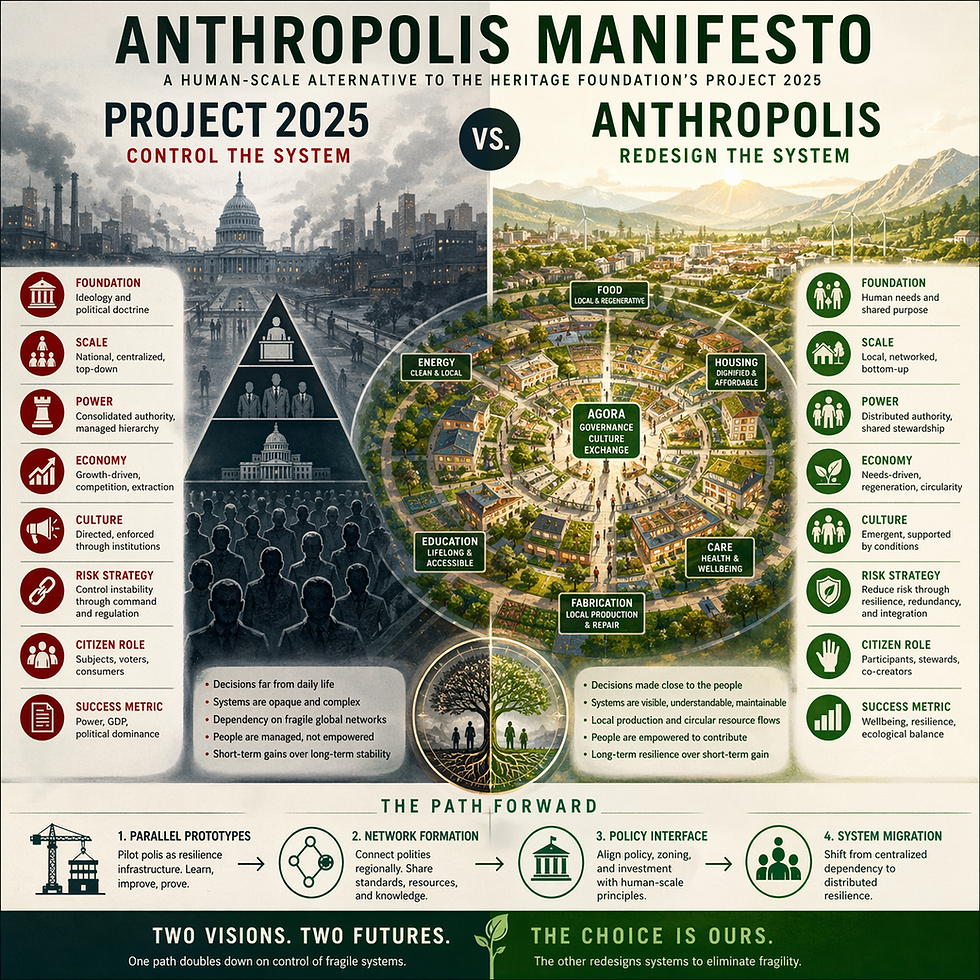
This is where Anthropolis enters the conversation.
Anthropolis begins with the recognition that when enough individuals experience the same misalignment, the problem is no longer personal. It is structural.
It asks what happens when isolated awareness becomes coordinated action.
What if food production, shelter, education, healthcare, technology, and civic participation were brought closer to the communities they serve? What if cause and effect became visible again? What if responsibility were shared rather than continually deferred to distant institutions and corporations?
Anthropolis does not ask people to escape civilization.
It asks them to help redesign it.
The self-imposed exile therefore need not remain an outsider. What initially felt like separation can become community. What began as individual discomfort can become collective purpose.
Eventually, those who stepped away begin recognizing one another.
They discover they were never truly alone.
They were simply scattered.
So hold your position. Refine your participation. Find those doing the same.
And build.
Because systems do not change merely because people expose what is wrong with them.
They change when enough people stop reinforcing what no longer works and begin, piece by piece, constructing what does.
You have already begun.
And you are not alone.